Blog

Comments on a manuscript

Quick comments on the new King and Worthington working paper on AI article reviews

The new King and Worthington working paper, AI Article Reviews Dominate Human Peer Reviews at Their Best: Evidence and Policy Choices, is interesting. Not so sure about Kent Anderson’s comments on it, especially where he says that peer review is “first and foremost a selection step”, given that in 2022, mega-journals, typically associated with scientifically

Quick comments on the new King and Worthington working paper on AI article reviews Read More »
Minimalist document review interface

Quick test of Google’s Deep Review

Google has launched Deep Review, its AI system for reviewing and checking papers. It’s the public version of the Paper Assistant Tool described in its June preprint: Towards Automating Scientific Review with Google’s Paper Assistant Tool. The service gives you 2 free reviews per week with 4 Argon on Medium. If you are using the

Quick test of Google’s Deep Review Read More »

screenshot 2026 10 07 094559

AI verifiers are getting better and cheaper at finding errors in research papers

AI verifiers are getting better and cheaper at finding errors in research papers
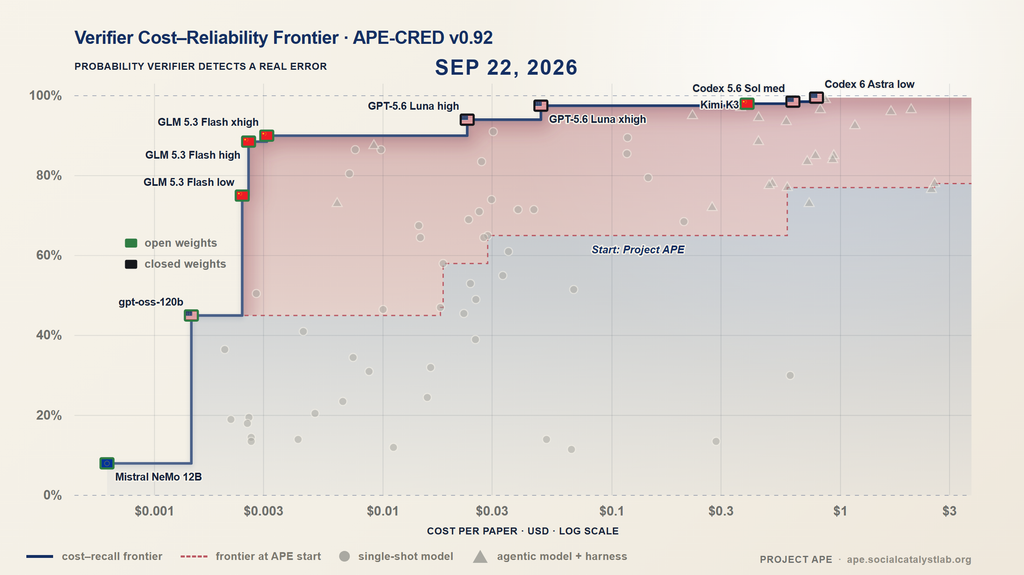
This is a lovely visualisation from Project APE at the University of Zurich’s Social Catalyst Lab, tracking how good AI verifiers are at finding deliberately planted errors in AI-generated research papers, and how much it costs to find them. Models released over the past 18 months went from finding about 4 in 10 errors to finding almost all of them, while the cost of finding roughly three-quarters of the errors fell about 1,000×, from $2.50 per paper for an August 2025 released model to $0.0025 with the latest models.

AI verifiers are getting better and cheaper at finding errors in research papers Read More »

digital minds sprint

Notes from the Apart Digital Minds sprint and the case for a guided platform

TL;DR: I took part in Apart Research’s Digital Minds sprint in August and learnt a lot. It was my first attempt at doing this kind of work. AI tools made it surprisingly easy to set up and run [poorly designed] experiments on how models describe their own preferences and experiences, but the model’s advice about

Notes from the Apart Digital Minds sprint and the case for a guided platform Read More »

Latest issue of PubTech Radar

PubTech Radar Scan: Issue 43

🚨 New issue of PubTech Radar is out: https://substack.com/@pubtechradar/p-202950318. Contents include: 📰 News: PLOS’s move to Janeway for submissions, Google letting publishers opt out of AI Overviews, Company of Biologists’ Fast & Fair trial cutting peer review decisions from 37.7 days to 5.5. BookStories (‘openscience.works), one of seven projects on the Dutch “Renew the Book 2026”

PubTech Radar Scan: Issue 43 Read More »

TAIS OXFORD

TAIS 2026: From model behaviour to system safety

TAIS 2026 was a one-day conference held at Oxford’s Examination Schools on 14 May 2026, organised by the Oxford Martin AI Governance Initiative and Noeon Research. It brought together researchers working across technical AI safety, governance, evaluation, autonomous systems and international cooperation. The meeting covered how models reason, scheming evaluations, autonomous agents, formal verification, human

TAIS 2026: From model behaviour to system safety Read More »

Event write up

AI in Peer Review: Highlights from the AI Publishing Collective Meetup

The recent AI Publishing Collective event at BCS London, hosted by BCSWomen, and BCS Publishing, brought together experts from across scholarly publishing to discuss how AI is shaping peer review and research integrity. AI + Preprint = The End of Journals? Chris Leonard opened the evening with a thought experiment: what would happen if we

AI in Peer Review: Highlights from the AI Publishing Collective Meetup Read More »

1750184120401

30 People to Follow at the Intersection of AI and Academic Publishing

These 30 people are navigating AI’s impact on academic publishing from the front lines. Whether they’re technologists experimenting with new workflows, librarians exploring new research assistants, or commentators tracking industry shifts, they’re openly documenting what works, what doesn’t, and what’s coming next. This living list captures people actively wrestling with these changes and writing about

30 People to Follow at the Intersection of AI and Academic Publishing Read More »